Used EV Inspection Checklist: How Visual AI Identifies Battery and Structural Risks
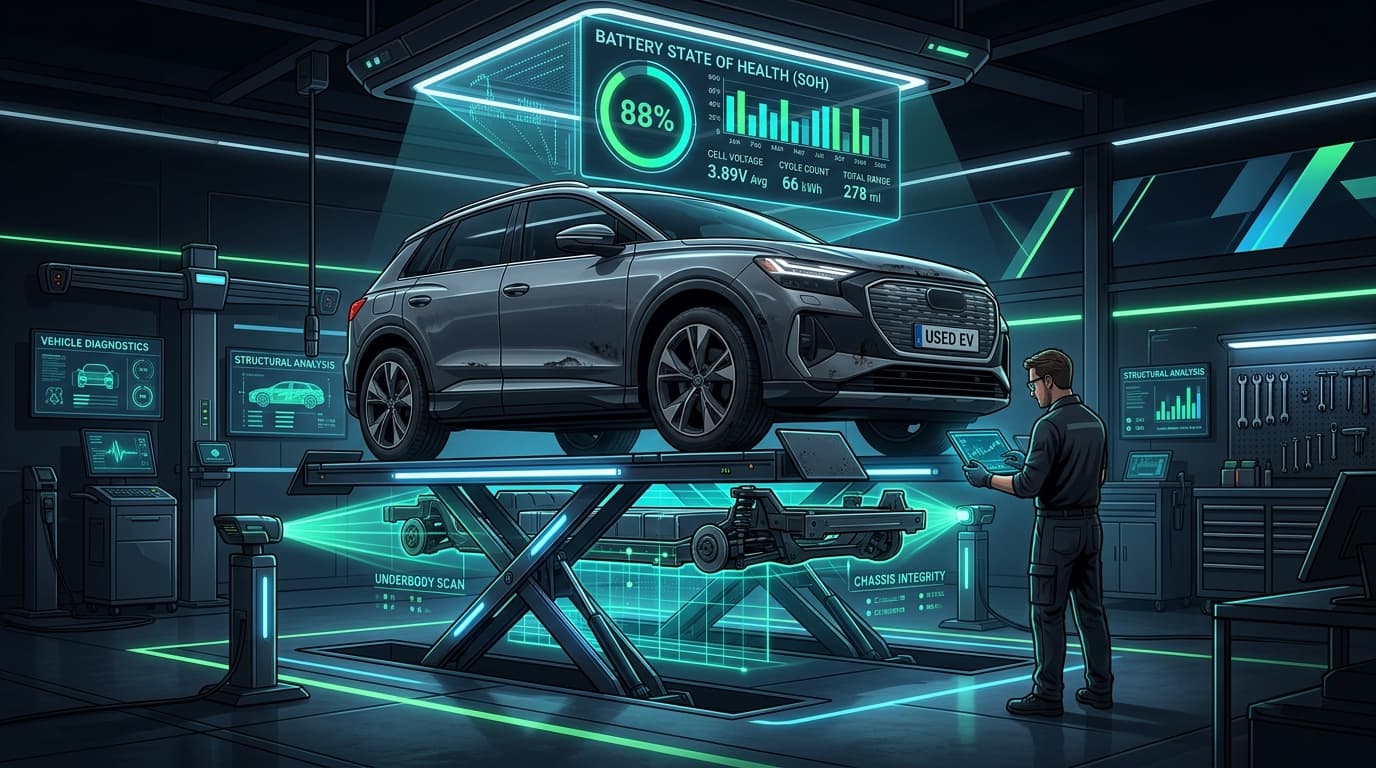
TL;DR Summary"Underbody damage to an EV's battery casing can lead to catastrophic failure. Use this checklist and visual AI to detect battery degradation and panel misalignment before buying."
1. Topic Context & Definition
A used EV inspection is a specialized assessment focusing on the battery's State of Health (SOH), the physical integrity of the underbody battery casing, and structural panel alignment.
Understanding EV Battery State of Health (SOH)
When evaluating a used electric vehicle (EV), the battery is the single most critical component to inspect. Unlike internal combustion engine (ICE) vehicles where engine wear is cumulative and highly complex, an EV\'s primary wear factor is battery capacity loss. This is measured via the **State of Health (SOH)** percentage.
An EV\'s SOH represents its current energy storage capacity relative to when it was brand new. For example, if a car had a 100 kWh battery at delivery and now has a SOH of 85%, its maximum capacity is restricted to 85 kWh, directly reducing its driving range by 15%. Because battery replacement costs can easily exceed $15,000, understanding and verifying this percentage is paramount for any used buyer.
### Key Factors Driving Battery Degradation: * **DC Fast Charging Habits:** Excessive reliance on ultra-fast chargers degrades cells due to thermal stress. * **Depth of Discharge (DoD):** Consistently running the battery down to 0% or charging it to 100% accelerates wear. * **Thermal Management:** Vehicles driven in extreme climates without active liquid cooling tend to degrade faster.
Underbody Battery Casing Integrity: The Invisible Risk
Most modern electric cars utilize a "skateboard" chassis architecture. This design houses the massive lithium-ion battery pack flat along the floor of the vehicle, protected by underbody shields. While this maximizes interior cabin space and improves handling, it introduces a severe vulnerability.
Road debris, high speed bumps, and curb bottom-outs can scrape or dent the protective plates of the battery pack. Since this damage happens underneath the car, it is rarely visible to a casual buyer.
### Risks Associated with Underbody Impact: 1. **Cell Intrusion & Fire:** Dents in the aluminum or steel battery casing can deform internal battery cells, potentially leading to short circuits and thermal runaway (battery fires). 2. **Voided Warranties:** Electric vehicle manufacturers are notorious for voiding the 8-year/100,000-mile battery warranty if they detect any physical impact marks or deformations on the outer shell. 3. **High Repair Costs:** Even minor casing deformations that do not affect performance can fail safety inspections, forcing a complete and expensive battery pack replacement.
Leveraging Visual AI to Detect Panel Gaps and Structural Impacts
Paying for multiple physical pre-purchase inspections (PPI) quickly becomes expensive. Buyers need an efficient way to filter out vehicles before committing to a mechanic inspection.
**Arabal AI** utilizes advanced computer vision models to inspect listing photos for micro-anomalies. By scanning the gaps between exterior panels (doors, hood, fenders, and quarter panels), the AI identifies uneven spaces and misalignments that human eyes often overlook.
Uneven panel alignment is a clear indicator of previous collision damage. A vehicle that has sustained a major side or front impact might have suffered structural warping. This kinetic energy transfers directly to the rigid skateboard chassis frame, putting the battery pack at risk of internal stress fractures. Using visual AI allows you to spot these red flags remotely, protecting your budget and ensuring you only inspect high-quality cars.
| Evaluation Point | Traditional Physical PPI | Arabal AI Pre-Filter & SOH Check |
|---|---|---|
| Cost Profile | $150 - $300 per inspection | Instant credit-based (highly affordable) |
| Underbody Shell Check | Requires workshop lift and visual check | Predicts structural impact via exterior panel alignment |
| Battery Diagnostics | OBD diagnostics scan (often static codes) | Comprehensive SOH degradation and range verification |
| Time Commitment | 1 to 2 hours + travel time | Seconds via digital listing scan |